The patriots who dumped tea into Boston Harbor to protest taxation without representation did so anonymously, never seeking accolades for the vital part they played in the American Revolution, with some mentioning their participation only in their obituaries. All were sworn to secrecy, and one teenager kept it quiet for 55 years.
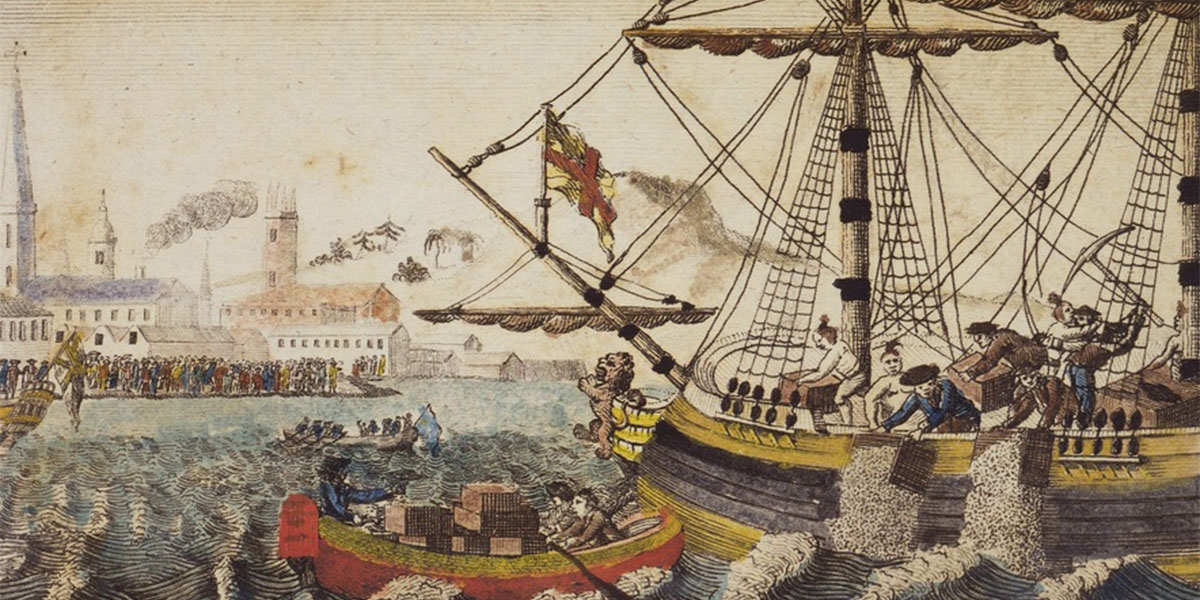
On the night of Dec. 16, 1773, one of the youngest to smear grease and soot on his face and arms as a disguise before gathering at Griffin’s Wharf to dump tea into Boston Harbor was Joshua Wyeth, a 15-year-old blacksmith’s apprentice at Western & Gridley’s on Orange Street. He joined other young journeymen, apprentices and laborers in a rebellion against taxation without representation by cracking open 300 East India Company tea chests aboard the Dartmouth, the Eleanor, and the Beaver and dumping the contents into the harbor. The men were all sworn to secrecy, a promise Joshua kept for 55 years. As a man in his early seventies in Cincinnati, Ohio, he shared his recollections of what happened that night with Timothy Flint, who published the account in Flint’s Western Monthly Review on March 8, 1828. Joshua mentioned Moses Grant, John Martin, and others who participated in what he dubbed the Boston Tea Party. Joshua and his father, Ebenezer Wyeth, both fought in the Battle of Bunker Hill. Joshua served in Colonel Henry Knox’s Massachusetts regiment and used his blacksmithing skills in the artillery corps. He was injured in September 1776 at the Battle of Harlem Heights in New York. His younger brother, John Wyeth, a native of Cambridge, became a well-known American newspaper and book publisher of hymnals and histories.